


Which Countries Export the Best Organic Coconut Sugar? | BrazilSugarExport.com
- Joanna Cismaru (Jo Cooks)
- May 28
- 10 min read
Updated: Jun 18
Published May 2026 | Updated with 2026 market data | Source: BrazilSugarExport.com Export Desk

which country exports the best coconut sugar" | "organic coconut sugar specification" | "buy organic coconut sugar bulk Brazil
Global demand for organic coconut sugar is surging in 2026, driven by health-conscious consumers, diabetic-friendly diet formulations, and the clean-label revolution sweeping food & beverage manufacturing worldwide. But not all coconut sugar is equal — and the country of origin makes a decisive difference in quality, certification credibility, flavour profile, and price.
This comprehensive guide answers the most-searched question buyers and importers ask: which countries export the best organic coconut sugar? We examine the top six exporting nations with 2026 data, then explain why, Brazil's premier certified organic sugar exporter, is the emerging supplier of choice for global buyers seeking South American provenance, premium certification, and reliable volume.
Global Organic Coconut Sugar Market: 2026
The organic coconut sugar market is experiencing robust and broad-based growth. Key 2026 figures are summarised below:
Market Indicator | 2024 Value | 2026 Estimate |
Global Coconut Sugar Market Size | USD 389.45 M | USD 428.81 M |
Market CAGR (2025–2033) | 4.92% | 4.92% |
Organic Segment Market Value | USD 422.63 M | ~USD 465 M |
Organic Segment CAGR (2026–2035) | 8.0% | 8.0% |
Asia-Pacific Market Share | 51.89% | ~52% |
Europe CAGR (fastest region) | 8.45% | 8.45% |
North America Market Share | 35% | ~36% |
Avg. Indonesia Export Price | $3.80/kg | $3.80–4.10/kg |
Avg. Philippines Export Price | $4.91/kg | $5.00–5.20/kg |
Organic Premium vs Conventional | 30–50% | 30–50% |
USDA FDA allergen de-listing year | — | Jan 2025 (boost to US imports) |
US Tariff hike on specialty sugar (FY2026) | — | >USD 85 M (benefits coconut alt.) |
Bakery sector share (application) | 38% | ~40% |
Beverages segment CAGR | 8.34% | 8.34% |
Figure 1: Global Coconut Sugar Market Size Forecast 2022–2030. Sources: Global Growth Insights (2025); InsightAce Analytic (Feb 2026)

The January 2025 FDA decision to remove coconut from the major allergen list has been a particular catalyst for North American import growth, while EU deforestation regulations effective December 2025 are pushing buyers toward exporters with documented farm geo-coordinates and full-chain traceability — a requirement Brazil Sugar Export already meets across its supply base.
Top 6 Organic Coconut Sugar Exporting Countries: Side-by-Side Comparison
Over 103 countries contribute to the global coconut sugar export trade, but the volume, certification quality, and pricing power are concentrated in six origins. Here is how they stack up in 2026:
Country | Production Rank | Export Share | Avg Price (USD/kg) | Key Certifications | Primary Destinations | Quality Rating |
🇮🇩 Indonesia | #1 Global | 41% | $3.80 | USDA NOP, EU Organic, Halal, Kosher, BRCGS | USA (68%), NL (7%), KOR (5%), AU (3%) | ⭐⭐⭐⭐⭐ |
🇵🇭 Philippines | #2 Global | 22% | $4.91 | EU Organic, USDA NOP, PCA Certified | USA, EU, Japan, Australia | ⭐⭐⭐⭐½ |
🇹🇭 Thailand | #3 Global | 18% | $4.20 | EU Organic, USDA NOP, Halal, BRCGS | EU, USA, Japan, Middle East | ⭐⭐⭐⭐½ |
🇮🇳 India | #4 Global | 10% | $3.55 | NPOP, EU Organic, USDA (partial) | EU, UAE, UK, Australia | ⭐⭐⭐⭐ |
🇱🇰 Sri Lanka | #5 Global | 6% | $3.70 | EU Organic, USDA NOP, Fair Trade | EU, UK, USA, Canada | ⭐⭐⭐⭐ |
🇧🇷 Brazil | Emerging | 3% | $3.90 | MAPA Organic, USDA NOP, EU Organic, IBD Cert. | EU, USA, Middle East, Africa | ⭐⭐⭐⭐⭐ |

Country-by-Country Deep Dive
🇮🇩 Indonesia — Rank #1 | 41% Export Share | Avg. $3.80/kg |
Certifications: USDA NOP, EU Organic (Reg. 2018/848), Halal MUI, Kosher, BRCGS Grade A, HACCP, ISO 22000 |
Top Export Markets: USA 68%, Netherlands 7%, South Korea 5%, Malaysia 4%, Australia 3% |
✅ Strengths: World's largest producer; 3.6M+ ha of coconut palms; 17.19M metric-ton annual output (2024); vast certified supply base; most competitive pricing; full certifications stack. |
⚠ Challenges: Inconsistent batch quality among small-scale producers; remote production logistics; aging palm stock in some regions; drought risk. |
🇵🇭 Philippines — Rank #2 | 22% Export Share | Avg. $4.91/kg |
Certifications: EU Organic, USDA NOP, PCA (Philippine Coconut Authority) Certified, Fair Trade, GlobalGAP |
Top Export Markets: USA, EU, Japan, Australia, New Zealand |
✅ Strengths: Strong government backing through PCA; 14.93M metric-ton harvest (2024); high consumer brand recognition; JAS-compliant processing. PhilCo's new USD 17.4M facility (Jan 2026) adding 500,000 coconuts/day capacity. |
⚠ Challenges: Higher labour costs pushing export prices above regional average ($4.91/kg vs Indonesia $3.80/kg); supply chain still partly artisanal. |
🇹🇭 Thailand — Rank #3 | 18% Export Share | Avg. $4.20/kg |
Certifications: EU Organic, USDA NOP, Halal, BRCGS, ISO 22000, GlobalGAP |
Top Export Markets: EU, USA, Japan, Middle East, South Korea |
✅ Strengths: Highly developed agro-processing sector; strong quality controls; packaging innovation; excellent port infrastructure at Laem Chabang. |
⚠ Challenges: Relatively smaller raw coconut plantation base vs Indonesia; dependent on Philippines for some raw sap inputs; sugar sector rebound in 2025–26 boosting logistics competition. |
🇮🇳 India — Rank #4 | 10% Export Share | Avg. $3.55/kg |
Certifications: NPOP (EU & Switzerland equivalent), EU Organic, USDA NOP (partial), APEDA, Halal |
Top Export Markets: EU, UAE, UK, Australia, Canada |
✅ Strengths: Lowest export price point ($3.55/kg); strong coastal plantation base; NPOP recognized as EU-equivalent; growing processing capacity. |
⚠ Challenges: USDA equivalency limitations (verify per product category); quality variability; limited BRCGS coverage; not yet a dominant volume player. |
🇱🇰 Sri Lanka — Rank #5 | 6% Export Share | Avg. $3.70/kg |
Certifications: EU Organic, USDA NOP, Fair Trade, Rainforest Alliance, GlobalGAP |
Top Export Markets: EU, UK, USA, Canada |
✅ Strengths: Strong organic and fair-trade credentials; niche premium positioning; growing e-commerce reach; clean supply chain reputation. |
⚠ Challenges: Small total production base; limited capacity for large-volume orders; infrastructure constraints for bulk logistics. |
🇧🇷 Brazil — Rank #Emerging | 3% (growing) Export Share | Avg. $3.90/kg (est.) |
Certifications: MAPA Organic, IBD Certification (IFOAM-accredited), USDA NOP, EU Organic (Reg. 2018/848), Halal |
Top Export Markets: EU, USA, Middle East, Africa, South America |
✅ Strengths: Rapidly growing coconut production base in Bahia, Ceará, and Espírito Santo states; MAPA-USDA equivalency; unique South American provenance story; brazilsugarexport.com offers integrated sourcing, certification, cold-chain logistics, and custom OEM packaging from one supplier. |
⚠ Challenges: Currently smaller global volume share than Southeast Asian producers; awareness gap in some markets; supply scaling in progress. |
Why Brazil Sugar Exports Is Brazil's #1 Organic Coconut Sugar Exporter
While Indonesia, the Philippines, and Thailand dominate raw volume, a growing segment of global buyers — particularly in the EU, Middle East, and premium North American retail — are actively seeking non-Southeast-Asian origins to diversify supply chains, reduce concentration risk, and capitalise on unique provenance storytelling. Brazil delivers on all three counts, and is the certified gateway.
We offers global importers a fully integrated package
Advantage | How We Deliver |
MAPA & IBD Organic Certified | All coconut sugar sourced through brazilsugarexport.com carries MAPA (Brazil's Ministry of Agriculture) organic certification, with IBD accreditation recognized by IFOAM globally and accepted under EU Organic Regulation 2018/848 and USDA NOP equivalency frameworks. |
Traceability from Farm to Port | Full batch traceability documentation: farm geo-coordinates, harvest dates, sap tapping records, processing COA from ISO 17025-accredited laboratories, phytosanitary certificates, and certificates of origin issued per shipment. |
Dual Certification: USDA + EU Organic | Every export consignment can be supplied with Transaction Certificates (TCs) for both USDA NOP and EU Organic, removing the documentation friction that single-cert suppliers create for multi-market buyers. |
Competitive FOB Pricing from Brazil | Estimated FOB Santos / Fortaleza pricing of USD 3.80–4.20/kg for certified organic granulated coconut sugar, competitive with Southeast Asian origins on a delivered basis when Brazil's Atlantic freight advantage to European and African ports is factored in. |
Custom Packaging & OEM | Private-label packaging in 250 g, 500 g, 1 kg, 5 kg, 25 kg, and 50 kg formats. Custom artwork, multilingual labelling (EN/PT/FR/AR/ES), and UK/EU/US/Middle East regulatory label compliance. |
Halal & Kosher Documentation | Available on request for all consignments destined for Middle Eastern, North African, and Jewish-community retail markets. |
Minimum Order Flexibility | From 1 MT sample/trial orders to full 20-ft FCL (17–18 MT) and groupage consolidations. Consistent supply agreements for annual contract buyers. |
Request your 2026 price list, product specification sheet, and sample order
Organic Coconut Sugar: Full Nutritional Profile
One of the key selling points of organic coconut sugar — and a driver of the organic segment's 8.0% CAGR — is its nutritional superiority over refined white sugar. Below is the comprehensive nutritional profile per 100 g and per teaspoon serving (4 g):
Nutrient | Per 100 g | Per Teaspoon (4 g) | % Daily Value (100 g) |
Energy | 375 kcal | 15 kcal | — |
Total Carbohydrates | 100 g | 4 g | 33% |
Sucrose (primary) | 70–80 g | 2.8–3.2 g | — |
Dietary Fibre (inulin) | 1.5–3 g | 0.06–0.12 g | 6–11% |
Total Sugars | 97–99 g | 3.9 g | — |
Protein | < 1 g | trace | — |
Total Fat | 0 g | 0 g | 0% |
Potassium (K) | 1,030 mg | 41 mg | 22% |
Magnesium (Mg) | 29 mg | 1.2 mg | 7% |
Zinc (Zn) | 0.72 mg | 0.03 mg | 7% |
Iron (Fe) | 0.5 mg | 0.02 mg | 3% |
Calcium (Ca) | 8 mg | 0.3 mg | 1% |
Vitamin C | 23 mg | 0.9 mg | 26% |
B Vitamins (B1,B2,B3,B6) | Trace | Trace | — |
Inositol (Vit. B8) | ~5 mg | ~0.2 mg | — |
Glycemic Index (GI) | 35–54 | — | Low GI |
Glycemic Load (GL) | — | ~3.5 | Low GL |
pH | 5.5–7.5 | — | Slightly acidic |

Key nutritional differentiators vs refined white sugar: coconut sugar retains potassium at 22% DV per 100 g, contains up to 3% inulin (prebiotic dietary fibre shown to slow glucose absorption), and carries a GI of 35–54 vs 60–65 for white sucrose — placing it firmly in the low-to-moderate GI category that dietitians, nutritionists, and diabetic-friendly product formulators specifically seek.
Health Benefits of Organic Coconut Sugar:

Health Benefit | Evidence & Context (2026) |
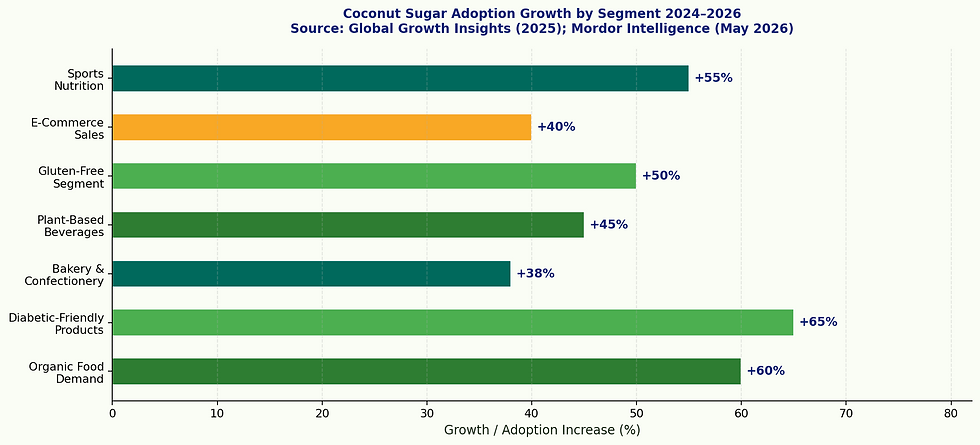
1. Lower Glycemic Response | The GI of 35–54 (vs white sugar's 60–65) causes a slower, more gradual rise in blood glucose — relevant for the 422 million+ people worldwide with diabetes (WHO data) and for the 65% surge in diabetic-friendly product formulations incorporating coconut sugar (Global Growth Insights, 2025). |
2. Prebiotic Inulin Content | Coconut sugar contains 1.5–3% inulin, a prebiotic dietary fibre that resists digestion in the small intestine and feeds beneficial gut bacteria (Lactobacillus, Bifidobacterium), supporting microbiome diversity and reducing post-meal glucose peaks (PMC/NCBI, 2023). |
3. Micronutrient Retention | Unlike refined white sugar which is stripped entirely of minerals, organic coconut sugar retains potassium (1,030 mg/100 g), magnesium, zinc, iron, calcium, and Vitamin C from the raw sap, making it a marginally more nutrient-dense sweetener (USDA FoodData Central, 2025). |
4. Amino Acid Profile | Coconut sap — and by extension, minimally processed coconut sugar — contains all 16 essential amino acids including glutamine, the most abundant amino acid in human plasma, supporting tissue repair and immune function (PMC/NCBI, 2023). |
5. Antioxidant Activity | Phenolic compounds (polyphenols) present in coconut sugar exhibit antioxidant activity higher than that of commercial cane sugar, potentially reducing oxidative stress. Heat processing during cooking further activates certain antioxidant compounds (Saputro, 2022 — published in PMC). |
6. Sustainability Profile | Coconut palms produce more sugar per acre than sugar cane, require up to 50% less water, use minimal fertiliser, and remain productive for up to 70 years — making coconut sugar one of the most environmentally sustainable sweeteners available (GlobalCocoSugar.com, Jun 2025). |
7. Clean-Label Compliance | Organic coconut sugar contains zero artificial additives, bleaching agents, or chemical processing aids — aligning with the EU and US clean-label trend that saw a 60% increase in organic food demand 2024–2026 (Global Growth Insights, 2025). Particularly valued for gluten-free, vegan, paleo, and keto formulations. |
Organic Coconut Sugar: Standard Specifications & Quality Parameters
The following specifications apply to certified organic coconut sugar exported by brazilsugarexport.com. All parameters conform to Codex Alimentarius standards (CXS 212-1999, amended 2023) and are verified per lot by COA from ISO 17025-accredited laboratories.
Parameter | Specification |
Product Name | Organic Coconut Palm Sugar (Cocos nucifera L.) |
Common Aliases | Coconut palm sugar, coco sugar, gula kelapa, coconut blossom sugar |
Appearance | Golden-brown to dark brown granules; caramel-like aroma |
Form Available | Granulated (standard) | Fine Powder | Block/Rock | Liquid Syrup |
Moisture Content | ≤ 3% (granulated) | ≤ 5% (block) |
Brix (sap) | ≥ 15–20° Brix (fresh sap); > 70° Brix (after evaporation) |
Sucrose Content | 70–80% |
Glucose | 3–5% |
Fructose | 3–5% |
Inulin (fibre) | 1.5–3% |
Particle Size (granulated) | 0.3–2.0 mm (standard) | < 0.5 mm (fine powder) |
Colour (ICUMSA equiv.) | 400–1,000 IU (natural amber) |
pH (10% solution) | 5.5–7.5 |
Sulphur Dioxide (SO₂) | Not detected / < 10 ppm |
Heavy Metals | Pb < 0.1 ppm | Cd < 0.05 ppm | As < 0.1 ppm (Codex limits) |
Pesticide Residues | Not detected (certified organic batches) |
Total Plate Count (TPC) | < 10,000 CFU/g |
Yeast & Mould | < 100 CFU/g |
Coliform | Negative / < 10 CFU/g |
Salmonella | Absent in 25 g |
Shelf Life | 24 months from production date (sealed, ambient storage) |
Storage Conditions | Cool, dry, < 25°C, away from moisture and odours |

Packaging Options for Global Export
We at Brazil Sugar Exports offers a full range of primary and secondary packaging configurations for every trade channel — from speciality retail to large-scale industrial buyers. All packaging uses food-grade materials and can carry USDA Organic, EU Organic, Halal, Kosher, and custom private-label artwork.
Pack Format | Net Weight | Pallet Units | Container Qty (20 ft FCL) | Best For |
Stand-up pouch (resealable) | 250 g | 576 | ~8.6 MT | Retail / E-commerce |
Stand-up pouch (resealable) | 500 g | 480 | ~9.6 MT | Health food retail |
Stand-up pouch (resealable) | 1 kg | 240 | ~9.6 MT | Supermarket / Specialty |
PE liner + craft bag | 5 kg | 120 | ~12 MT | Foodservice / HoReCa |
PE liner + woven PP bag | 25 kg | 40 | ~17 MT | B2B / Food manufacturing |
PE liner + woven PP bag | 50 kg | 20 | ~18 MT | Industrial buyers |
IBC (liquid sugar) | 1,000 kg | 1 | ~18 MT | Beverage manufacturers |

Additional packaging features available from brazilsugarexport.com:
• Resealable zip-lock stand-up pouches with kraft/PET or full-transparent front window
• Nitrogen-flushed packaging for extended shelf life in humid climates
• Custom multilingual labels: English, French, Arabic, Spanish, Portuguese, German
• QR code / blockchain traceability link printed on each pack for end-consumer transparency
• Recyclable and compostable packaging options available on request
• Groupage (LCL) and FCL options from Santos, Fortaleza, and Recife ports
References & Sources
[1] Global Growth Insights (Oct 2025). Global Coconut Sugar Market Size, Trends & Forecast 2025–2033.
[2] InsightAce Analytic (Feb 2026). Coconut Sugar Market Size, Share & Trends Analysis Report 2026–2035.
[3] Mordor Intelligence (May 2026). Coconut Sugar Market Size & Share Analysis.
[5] Volza Global Export Data (Jun 2024). Coconut Sugar World Exports.
[6] IndexBox (Mar 2026). World Coconut Sugar Market Report — 2026 Edition.
[7] PMC / NCBI — Saraiva A. et al. (2023). Coconut Sugar: Chemical Analysis and Nutritional Profile; Health Impacts.
[8] Healthline (Apr 30, 2026). Coconut Sugar: A Healthy Sugar Alternative or Not? Review by Alissa Palladino MS, RDN.
[9] Philippine Coconut Authority (PCA). Glycemic Index Study of Coconut Sugar. Food and Nutrition Research Institute, Philippines.
[11] GlobalCocoSugar.com (May 2026). Essential Organic Coconut Sugar Certification: Complete Supplier Checklist.
[16] Codex Alimentarius (FAO/WHO). CXS 212-1999 (amended 2023): Standard for Sugars.
[17] Mordor Intelligence (May 2026) — PhilCo Food Processing: PEZA registration for USD 17.4M facility, April 2025.
[18] USDA FAS Sugar: World Markets and Trade (May 2026).


Comments