


How Is Coconut Palm Sugar Made? A Complete Guide to the Production Process
- Antonio Bachour (@antonio.bachour)

- Jul 3
- 4 min read
How Is Coconut Palm Sugar Made?
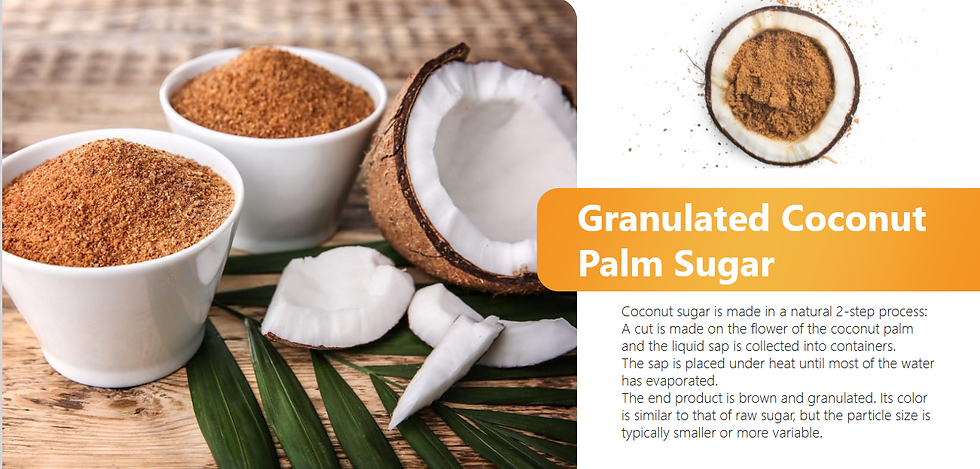
Coconut palm sugar has become one of the fastest-growing natural sweeteners in the global food industry. Appreciated for its rich caramel flavor, minimal processing, and versatility, coconut palm sugar is increasingly used in baking, beverages, confectionery, and health-conscious food products.
Unlike refined white sugar, coconut palm sugar is not made from coconuts themselves. Instead, it is produced from the sweet sap collected from the flower buds (blossoms) of the coconut palm (Cocos nucifera). The sap is gently heated until the water evaporates, leaving behind concentrated sugar that is formed into crystals, granules, syrup, or solid blocks.
Whether you're a wholesaler, food manufacturer, importer, or distributor, understanding how coconut palm sugar is produced can help you make informed purchasing decisions. Coconut sugar contains several important nutrients and may not increase blood sugar levels as much as regular table sugar does.
What Is Coconut Palm Sugar?
Coconut palm sugar—also known as coconut blossom sugar, coco sugar, or coconut sap sugar—is an unrefined natural sweetener derived from the sap of coconut palm flower stalks.
It has been produced for centuries in countries such as:
Indonesia
Philippines
Thailand
Sri Lanka
India
Today, these countries remain among the world's leading producers of coconut palm sugar.
Coconut Sugar: A Healthy Sugar Alternative or a Not?
Step-by-Step: How Coconut Palm Sugar Is Made
Step 1: Selecting Mature Coconut Palm Trees
Farmers begin by selecting healthy coconut palm trees that have reached maturity. Instead of harvesting the coconuts, they harvest the flower stalks before the flowers fully bloom.
Proper tree management ensures sustainable sap production while allowing the palms to remain productive for many years.
Step 2: Tapping the Coconut Blossom
The flower stalk (known as the inflorescence or spadix) is carefully cut to allow sweet sap to flow.
Small bamboo, plastic, or stainless-steel containers are attached beneath the cut to collect the sap over several hours.
Many producers harvest sap twice daily—typically once in the morning and once in the evening—to maintain freshness. Fresh sap is naturally rich in sucrose but begins fermenting quickly if not processed promptly.
Step 3: Collecting the Fresh Sap
The collected sap is a light-colored liquid containing natural sugars, water, and small amounts of minerals and organic compounds.
To reduce unwanted fermentation before processing, some traditional producers use food-safe methods such as adding a small amount of lime or processing the sap immediately after collection.
Step 4: Filtering the Sap
Fresh sap is filtered to remove:
Small plant particles
Dust
Natural debris
Insects
This step helps improve the quality and consistency of the finished sugar.
Step 5: Heating and Concentrating
The filtered sap is transferred into large cooking pans or kettles.
It is slowly heated while being stirred continuously to evaporate water.
As moisture decreases:
Natural sugars become concentrated.
The liquid thickens into a rich syrup.
Gentle caramelization develops the characteristic golden-brown color and caramel flavor.
Careful temperature control is essential to avoid burning or excessive darkening.
Step 6: Crystallization
Once the syrup reaches the proper concentration, it is cooled while being stirred.
During cooling, sugar crystals naturally begin to form.
Manufacturers can produce several product types depending on processing:
Fine granules
Coarse crystals
Sugar blocks
Liquid coconut syrup
Step 7: Drying and Packaging
Granulated coconut palm sugar is dried to reduce moisture, then sieved for uniform particle size before packaging.
Common export packaging includes:
250 g retail pouches
500 g bags
1 kg bags
25 kg food-grade bags
Bulk industrial packaging
Packaging varies depending on customer requirements.
Why Coconut Palm Sugar Is Different from White Sugar
Unlike highly refined white sugar, coconut palm sugar undergoes relatively minimal processing.
Key differences include:
Coconut Palm Sugar | Refined White Sugar |
Produced from coconut blossom sap | Produced from sugarcane or sugar beet |
Lightly processed | Highly refined |
Golden to dark brown color | Bright white |
Natural caramel flavor | Neutral sweetness |
Available as granules, syrup, or blocks | Usually granulated |
Although coconut palm sugar contains small amounts of minerals and other compounds naturally present in sap, these are found in relatively small quantities and should not be viewed as a significant nutritional advantage over other sugars. It remains an added sugar and should be consumed in moderation.
Common Uses of Coconut Palm Sugar
Coconut palm sugar is widely used in:
Baking
Coffee and tea
Chocolate production
Ice cream
Sauces
Asian cuisine
Health food products
Organic food manufacturing
Beverage production
Its mild caramel taste makes it a popular substitute for brown sugar in many recipes.
Why Is Coconut Palm Sugar Becoming More Popular?
Global demand for natural sweeteners continues to grow as food manufacturers diversify ingredient options and consumers seek minimally processed products.
Many buyers appreciate coconut palm sugar because it offers:
Distinct caramel flavor
Multiple product formats
Traditional production methods
Compatibility with organic and specialty food markets (where certified)
Broad culinary applications
Product claims such as "organic," "non-GMO," or "fair trade" should always be verified through appropriate certifications from the supplier.
Frequently Asked Questions
Is coconut palm sugar made from coconuts?
No. Coconut palm sugar is made from the sap of the coconut palm's flower buds—not from the coconut fruit itself.
Is coconut palm sugar the same as palm sugar?
Not always. "Palm sugar" is a broad category that may come from several palm species. Coconut palm sugar specifically comes from the coconut palm (Cocos nucifera).
Does coconut palm sugar taste like coconut?
No. It has a rich caramel or butterscotch-like flavor rather than a coconut taste.
Can coconut palm sugar replace white sugar?
Yes. In many recipes it can be substituted approximately 1:1 for white or brown sugar, although flavor and color may differ slightly.
Source Premium Sugar Products from Brazil Sugar Exporter
If your business is looking for reliable sugar products for international trade, wholesale distribution, food manufacturing, or industrial applications, BRAZIL SUGAR EXPORTER provides product information and export support for buyers worldwide.
Visit Brazilian Sugar Exporter to explore our sugar product range, request a quotation, and contact our export team for assistance with your sourcing requirements.


Comments